Updated OGEA-103 Demo & New OGEA-103 Test Prep
Wiki Article
P.S. Free 2026 The Open Group OGEA-103 dumps are available on Google Drive shared by ValidBraindumps: https://drive.google.com/open?id=1q6Ga24mw1TJ3M-FYC4_PgYI1BIYkW7fG
Firmly believe in an idea, the OGEA-103 copyright questions are as long as the candidates to follow our steps, follow our curriculum requirements, they can be good to achieve their goals, to obtain the qualification OGEA-103 certificate of the target easily and soothly. For we have been in this career for years, we dare to say that no body can know the copyright questions and answers better than our professionals. And our pass rate of our OGEA-103 Study Materials is high as 98% to 100%!
Passing the OGEA-103 Certification copyright is a significant achievement for enterprise architects. TOGAF Enterprise Architecture Combined Part 1 and Part 2 copyright certification demonstrates that an individual has a deep understanding of the TOGAF framework and can apply it to complex enterprise architecture problems. TOGAF Enterprise Architecture Combined Part 1 and Part 2 copyright certification also indicates that an individual has the skills and knowledge necessary to work effectively with stakeholders and lead enterprise architecture initiatives. TOGAF Enterprise Architecture Combined Part 1 and Part 2 copyright certification is recognized globally and provides individuals with a competitive edge in the job market.
New The Open Group OGEA-103 Test Prep | Free OGEA-103 copyright
Our website gives detailed guidance to our customers for preparation of OGEA-103 actual test and take them towards the direction of achievement. Each of our The Open Group copyright preparation materials is designed by IT professionals in order to improve your particular skills. Our OGEA-103 Practice Questions will boost the confidence of candidates for appearing in the real copyright.
The Open Group TOGAF Enterprise Architecture Combined Part 1 and Part 2 copyright Sample Questions (Q131-Q136):
NEW QUESTION # 131
Exhibit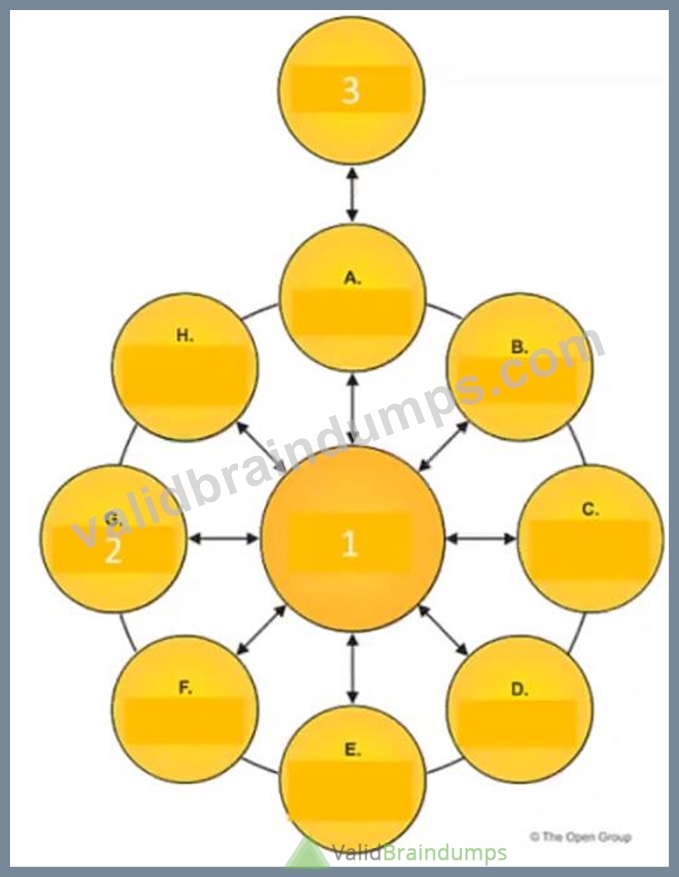
Consider the illustration showing an architecture development cycle Which description matches the phase of the ADM labeled as item 1?
- A. Conducts implementation planning for the architecture defined in previous phases
- B. Operates the process of managing architecture requirements
- C. Provides architectural oversight for the implementation
- D. Establishes procedures for managing change to the new architecture
Answer: A
Explanation:
The phase of the ADM labeled as item 1 is Phase F: Migration Planning. This phase conducts implementation planning for the architecture defined in previous phases by creating an Architecture Roadmap and a detailed Implementation and Migration Plan. This phase also identifies and groups major work packages, transition architectures, projects, and dependencies. Reference: https://pubs.opengroup.org/architecture/togaf9-doc/arch/chap19.html
NEW QUESTION # 132
Consider the following ADM phases objectives.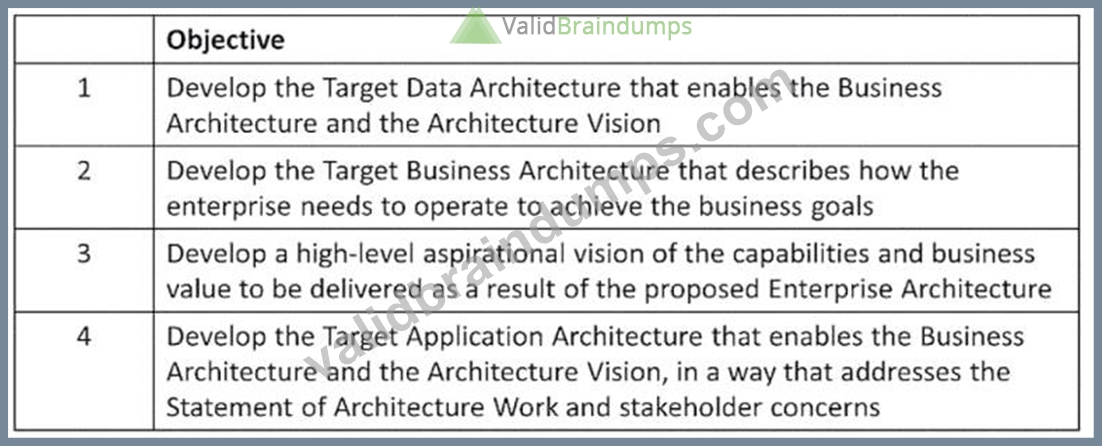
Which phase does each objective match?
- A. 1C-2B-3A-4C
- B. 1A-2B-3C-4D
- C. 1C-2D-3B-4A
- D. 1B-2D-3A-4C
Answer: A
Explanation:
* The objectives listed in the question correspond to the objectives of different phases of the TOGAF ADM (Architecture Development Method), which is a method for developing and managing an enterprise architecture1.
* The ADM consists of nine phases, each with a specific purpose and output. The phases are1:
* Preliminary Phase: To prepare and initiate the architecture development cycle, including defining the architecture framework, principles, and governance.
* Phase A: Architecture Vision: To define the scope, vision, and stakeholders of the architecture initiative, and to obtain approval to proceed.
* Phase B: Business Architecture: To describe the baseline and target business architecture, and to identify the gaps between them.
* Phase C: Information Systems Architectures: To describe the baseline and target data and application architectures, and to identify the gaps between them.
* Phase D: Technology Architecture: To describe the baseline and target technology architecture, and to identify the gaps between them.
* Phase E: Opportunities and Solutions: To identify and evaluate the opportunities and solutions for implementing the target architecture, and to define the work packages and transition architectures.
* Phase F: Migration Planning: To finalize the implementation and migration plan, and to ensure alignment with the enterprise portfolio and project management.
* Phase G: Implementation Governance: To provide architecture oversight and guidance for the implementation projects, and to manage any architecture change requests.
* Phase H: Architecture Change Management: To monitor the changes in the business and technology environment, and to assess the impact and performance of the architecture.
* Based on the above definitions, we can match each objective with the corresponding phase as follows:
* Objective 1: Develop the Target Data Architecture that enables the Business Architecture and the Architecture Vision. This objective is achieved in Phase C: Information Systems Architectures, where the data architecture is defined as a subset of the information systems architecture2.
* Objective 2: Develop the Target Business Architecture that describes how the enterprise needs to operate to achieve the business goals. This objective is achieved in Phase B: Business Architecture, where the business architecture is defined as a subset of the enterprise architecture3.
* Objective 3: Develop a high-level aspirational vision of the capabilities and business value to be delivered as a result of the proposed Enterprise Architecture. This objective is achieved in Phase A: Architecture Vision, where the architecture vision is defined as a high-level description of the target architecture and its benefits4.
* Objective 4: Develop the Target Application Architecture that enables the Business Architecture and the Architecture Vision, in a way that addresses the Statement of Architecture Work and stakeholder concerns. This objective is achieved in Phase C: Information Systems Architectures, where the application architecture is defined as a subset of the information systems architecture2.
References:
* 1: The TOGAF Standard, Version 9.2, Chapter 5: Architecture Development Method (ADM)
* 2: The TOGAF Standard, Version 9.2, Chapter 9: Phase C: Information Systems Architectures
* 3: The TOGAF Standard, Version 9.2, Chapter 8: Phase B: Business Architecture
* 4: The TOGAF Standard, Version 9.2, Chapter 7: Phase A: Architecture Vision
NEW QUESTION # 133
Which of the following best describes a Business Scenario?
- A. A method to quantify readiness for change.
- B. A technique to identify differences between a baseline and a target architecture.
- C. A business problem together with the desired outcome.
- D. A use-case for developing a business model.
Answer: C
Explanation:
Comprehensive and Detailed Explanation From documents:
In TOGAF, a Business Scenario is an ADM technique used to capture and structure business requirements in a way that directly informs the development and validation of architectures. It frames a specific business problem (or opportunity) and articulates the desired outcomes/objectives, along with the business and technical context, the involved actors and roles (human and system), and the measures of success. This makes option A correct because it concisely captures the essence of a Business Scenario: a well-defined business problem coupled with the outcomes the business seeks to achieve.
A good Business Scenario typically includes:
* The business problem/opportunity and drivers.
* The business and technical environment/context in which the problem exists.
* The desired outcomes/objectives and measures of success (how success will be recognized).
* Actors and roles (both human and system) and their interactions.
* Capabilities and high-level requirements implied by the scenario.
Business Scenarios are especially valuable in Phase A: Architecture Vision to validate scope, objectives, and business value, and they continue to be used throughout Phases B-D to test and validate the target architectures and to maintain requirements traceability via Requirements Management. They promote shared understanding among stakeholders and provide a concrete basis for evaluating solution options and assessing architecture fitness-for-purpose.
Why the other options are incorrect:
* B. A use-case for developing a business model. While Business Scenarios and use-cases are related, a Business Scenario is broader. It provides context, problem, objectives, and measures of success; use- cases are often derived from or complement Business Scenarios to specify interactions, but a Business Scenario is not merely a use-case.
* C. A method to quantify readiness for change. This describes Business Transformation Readiness Assessment, a separate TOGAF technique used to gauge an organization's readiness to execute change.
It is not what TOGAF defines as a Business Scenario.
* D. A technique to identify differences between a baseline and a target architecture. That is Gap Analysis, another distinct ADM technique used to determine what needs to change to move from the current state to the desired future state.
References (official TOGAF materials; no links):
* The Open Group, TOGAF Standard, Version 9.2, Part III: ADM Guidelines & Techniques - Business Scenarios; also Requirements Management, and Phase A: Architecture Vision (Part II) for where Business Scenarios are applied.
* The Open Group, TOGAF Series Guide: Business Scenarios - definition, structure, and usage of Business Scenarios across the ADM.
* The Open Group, TOGAF 9 Foundation Study Guide (latest edition) - coverage of Business Scenarios as an ADM technique and their relationship to use-cases.
* The Open Group, TOGAF 9 Certified Study Guide (latest edition) - contrasts with related techniques (Gap Analysis; Business Transformation Readiness Assessment) and explains use within Phase A and Requirements Management.===========
NEW QUESTION # 134
Complete the sentence The purpose of Enterprise Architecture is to_______________.
- A. control the bigger changes
- B. guide effective change
- C. govern the stakeholders
- D. take major improvement decisions
Answer: B
Explanation:
The purpose of Enterprise Architecture is to guide effective change by providing a coherent and consistent view of the enterprise's current and future state, as well as the roadmap and principles for achieving it.
Enterprise Architecture helps to align business and IT strategies, optimize resources and investments, reduce complexity and risks, enhance agility and innovation, and deliver value to stakeholders. Reference: The TOGAF Standard | The Open Group Website, Section 1.3 Executive Overview.
NEW QUESTION # 135
Consider the illustration.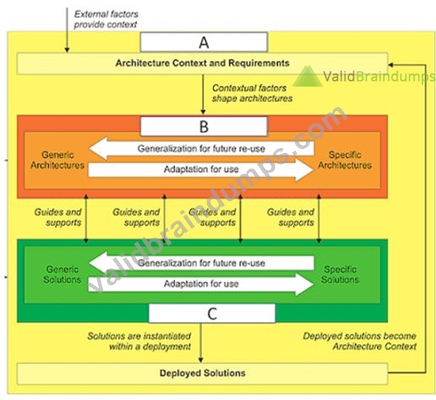
What are the items labelled A, B and C?
- A. A-Enterprise Architecture, B-Architecture Building Blocks, C-Solutions Building Blocks
- B. A-Enterprise Continuum, B-Architecture Continuum, C-Solutions Continuum
- C. A-Enterprise Strategic Architecture, B-Segment Architecture, C-Solutions Architecture
- D. A-Architecture Vision, B-Business Architecture, C-Information Systems Architecture
Answer: B
Explanation:
The illustration shows the relationship between the Enterprise Continuum, the Architecture Continuum, and the Solutions Continuum, which are key concepts in the TOGAF framework. The Enterprise Continuum is a view of the Architecture Repository that shows how generic foundation architectures can be leveraged and specialized to support the requirements of an individual organization. The Architecture Continuum specifies a structured classification for architectural artifacts, such as models, patterns, and descriptions, that can be reused and adapted across different domains and levels of abstraction. The Solutions Continuum identifies implemented solutions that support various stages of business and IT capability evolution, such as common systems, industry solutions, and organization-specific solutions. The illustration also shows how the architecture context and requirements are influenced by external factors, such as business drivers, stakeholders, and standards, and how they shape the generic and specific architectures and solutions. The illustration also shows how the deployed solutions become part of the architecture context for future iterations of the architecture development cycle.
Reference:
* TOGAF Standard, 10th Edition, Part II: Architecture Development Method, Chapter 6: Architecture Repository, Section 6.2 Enterprise Continuum.
* TOGAF Standard, 10th Edition, Part IV: Architecture Content Framework, Chapter 35: Enterprise Continuum and Tools, Section 35.1 Introduction.
NEW QUESTION # 136
......
We have applied the latest technologies to the design of our The Open Group OGEA-103 test prep not only on the content but also on the displays. As a consequence you are able to keep pace with the changeable world and remain your advantages with our TOGAF Enterprise Architecture Combined Part 1 and Part 2 copyright OGEA-103 Training Materials.
New OGEA-103 Test Prep: https://www.validbraindumps.com/OGEA-103-copyright-prep.html
- The Open Group OGEA-103 copyright | Updated OGEA-103 Demo - Provide you Best New OGEA-103 Test Prep ???? Search for ➥ OGEA-103 ???? and obtain a free download on 【 www.torrentvce.com 】 ????Test OGEA-103 Preparation
- OGEA-103 Reliable Torrent ⏪ OGEA-103 copyright ???? OGEA-103 copyright Material ???? Download ➤ OGEA-103 ⮘ for free by simply entering { www.pdfvce.com } website ????OGEA-103 copyright Material
- OGEA-103 Valid Test Tips ???? Test OGEA-103 Preparation ???? Test OGEA-103 Passing Score ???? Search on ➤ www.copyrightcollectionpass.com ⮘ for ➽ OGEA-103 ???? to obtain copyright materials for free download ????Reliable OGEA-103 Dumps Book
- 100% Pass 2026 Perfect The Open Group OGEA-103: Updated TOGAF Enterprise Architecture Combined Part 1 and Part 2 copyright Demo ???? Enter { www.pdfvce.com } and search for [ OGEA-103 ] to download for free ????OGEA-103 copyright
- 100% Pass 2026 Perfect The Open Group OGEA-103: Updated TOGAF Enterprise Architecture Combined Part 1 and Part 2 copyright Demo ???? Copy URL 《 www.copyrightcollectionpass.com 》 open and search for ➤ OGEA-103 ⮘ to download for free ????OGEA-103 Test Tutorials
- OGEA-103 Valid Test Tips ???? Training OGEA-103 Kit ❣ OGEA-103 Valid Test Tips ???? Download ▛ OGEA-103 ▟ for free by simply searching on ☀ www.pdfvce.com ️☀️ ????Reliable OGEA-103 Dumps Book
- Pass OGEA-103 copyright with Marvelous Updated OGEA-103 Demo by www.testkingpass.com ???? Open website “ www.testkingpass.com ” and search for ▷ OGEA-103 ◁ for free download ????Reliable OGEA-103 Dumps Book
- OGEA-103 copyright Questions Vce ???? Test OGEA-103 Preparation ???? OGEA-103 Test Tutorials ???? Copy URL ⇛ www.pdfvce.com ⇚ open and search for 【 OGEA-103 】 to download for free ????OGEA-103 Reliable Torrent
- Free PDF Quiz 2026 Marvelous OGEA-103: Updated TOGAF Enterprise Architecture Combined Part 1 and Part 2 copyright Demo ???? Search for ▛ OGEA-103 ▟ and download copyright materials for free through { www.copyright4labs.com } ????OGEA-103 copyright Questions Vce
- OGEA-103 Valid copyright Files ???? Training OGEA-103 Kit ☮ Reliable OGEA-103 Test Blueprint ???? Search for ➡ OGEA-103 ️⬅️ on 【 www.pdfvce.com 】 immediately to obtain a free download ????OGEA-103 copyright
- Reliable OGEA-103 copyright Answers ???? Detail OGEA-103 Explanation ???? Training OGEA-103 Kit ???? Search for ( OGEA-103 ) and obtain a free download on 「 www.practicevce.com 」 ????Reliable OGEA-103 Test Blueprint
- bookmarkvids.com, lilypupk327432.mysticwiki.com, cpfcordoba.com, lawsonpvpm143248.wikiusnews.com, kianaorpp673263.blogsidea.com, socialwebnotes.com, www.stes.tyc.edu.tw, neilsslv107669.cosmicwiki.com, finnianlvxi918132.blog2news.com, sparxsocial.com, Disposable vapes
BTW, DOWNLOAD part of ValidBraindumps OGEA-103 dumps from Cloud Storage: https://drive.google.com/open?id=1q6Ga24mw1TJ3M-FYC4_PgYI1BIYkW7fG
Report this wiki page